

Missing one compliance step can cost you thousands. Fines, fair housing lawsuits, and tenant disputes are not rare events for careless landlords. They happen to experienced property managers who assume they already know the rules. The truth is that federal, state, and local requirements overlap in ways that trip up even seasoned professionals. Advertising language, lease disclosures, accessibility requests, and eviction procedures all carry legal weight. This guide walks you through every stage of the rental process, from preparing your documents to handling tenant accommodation requests, so you can protect your investment and sleep easier at night.
Table of Contents
- What you need before you start: Key laws, documents, and resources
- Step-by-step compliance: From advertising to move-in
- Lease agreements and required disclosures: Getting the paperwork right
- Accessibility, accommodations, and handling compliance requests
- State-specific variances and common pitfalls: Fine print that gets landlords sued
- A smarter approach to property compliance: Preventing problems before they start
- How Blackstone can support your compliance journey
- Frequently asked questions
Key Takeaways
| Point | Details |
|---|---|
| Compliance is multi-step | Follow a sequence from advertising through move-in to prevent violations. |
| Paperwork must be precise | Lease agreements and disclosures are heavily regulated and costly if omitted. |
| Accessibility isn’t optional | Service animals and reasonable modifications are legally protected, whatever your policy. |
| Local laws vary | Double-check state and city requirements to avoid local traps. |
| Training beats mistakes | Annual education and checklists help eliminate unintentional violations and fines. |
What you need before you start: Key laws, documents, and resources
Before you list a single unit, you need a clear picture of the legal landscape. Property compliance is not one law. It is a layered system of federal rules, state statutes, and local ordinances that all apply at the same time.
At the federal level, the Fair Housing Act covers seven protected categories: race, color, national origin, religion, sex, disability, and familial status. HUD enforces these rules, and violations can result in fines starting at $21,663 for a first offense. Your state may add more protected categories on top of that.
Here is a snapshot of the compliance layers you are working within:
| Level | Examples | Who enforces it |
|---|---|---|
| Federal | Fair Housing Act, ADA, Lead Paint Disclosure | HUD, EPA, DOJ |
| State | Security deposit limits, notice periods, extra protected classes | State attorney general |
| Local | Rent control, licensing, habitability codes | City or county agencies |
Before you start the leasing process, gather these documents:
- Proof of ownership (deed or title)
- State-compliant lease template reviewed by a local attorney
- Lead paint disclosure form (required for all pre-1978 properties)
- Tenant selection criteria in writing, applied consistently to every applicant
- Local landlord license if your city requires one
- Security deposit receipt template with required state language
Pro Tip: Subscribe to your state's landlord association newsletter. Laws change every legislative session, and a $10 monthly membership can save you from a $10,000 fine.
Keeping all of these documents in one organized folder, physical or digital, makes audits and tenant disputes far easier to manage.
Step-by-step compliance: From advertising to move-in
With your tools and documents ready, here's exactly how to tackle compliance step by step.
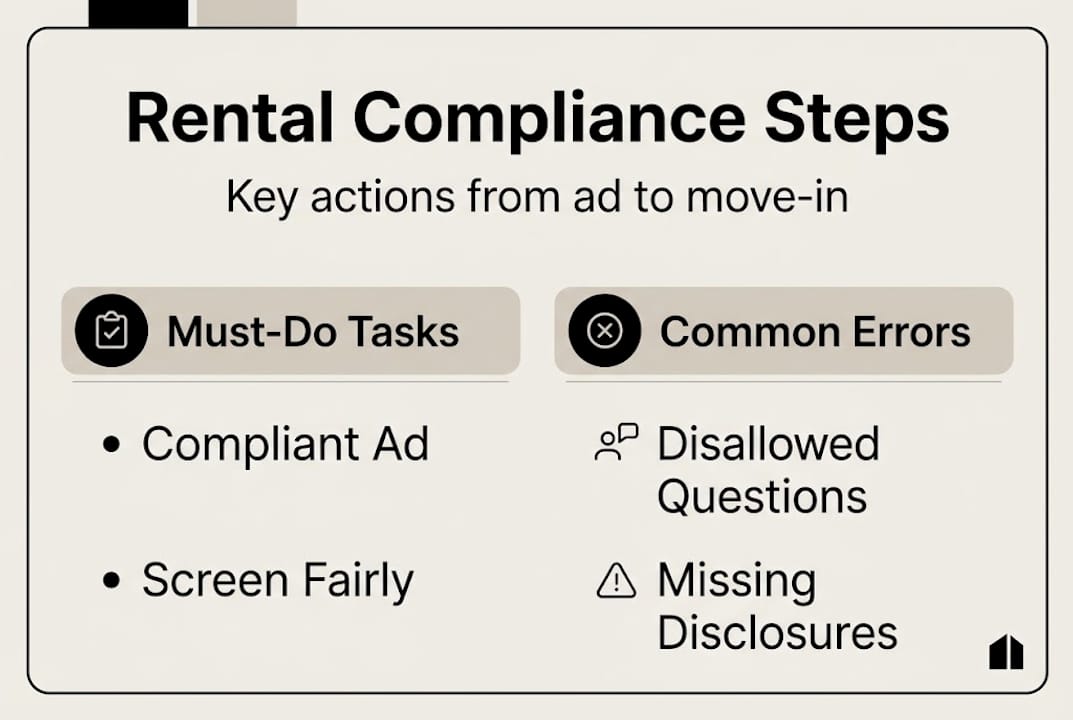
Most discrimination complaints start with problematic advertising or application screening. That means the risk begins before you ever meet a prospective tenant.
Step 1: Write a compliant rental ad. Describe the property, not the ideal tenant. Say "two-bedroom near downtown" not "great for young professionals." Phrases like "quiet neighborhood" or "perfect for couples" can imply preferences that violate fair housing rules.
Step 2: Create a written tenant selection criteria document. List your minimum income requirement (typically 2.5 to 3 times the monthly rent), credit score threshold, rental history standards, and criminal background check policy. Apply these criteria to every single applicant without exception.
Step 3: Use a compliant rental application. Do not ask about national origin, religion, disability, or family status. Ask only what you need to evaluate financial and rental history.
Step 4: Screen applicants consistently. Run the same checks on every applicant in the same order. Inconsistency is one of the fastest ways to trigger a discrimination complaint.
Step 5: Document your decision. Keep notes on why you approved or denied each applicant. Reference your written criteria. If you are ever challenged, documentation is your best defense.
Here is a quick comparison of legal versus prohibited screening practices:
| Legal screening | Prohibited screening | |---|---|---| | Credit score check | Asking about disability | | Income verification | Requiring no children | | Prior eviction history | Rejecting based on accent | | Criminal background check | Refusing based on national origin |
Pro Tip: Never tell an applicant a unit is unavailable when it is. Even a single instance of steering can result in a formal HUD complaint.
Lease agreements and required disclosures: Getting the paperwork right
Once you've chosen a tenant, the next step is locking in compliant paperwork.

A lease is not just a contract between two people. It is a legal document that must meet federal and state requirements. Missing one required clause can void your ability to enforce key terms, including eviction.
Every lease should include:
- Names of all adult tenants who will occupy the unit
- Exact rent amount and due date
- Security deposit amount and return timeline per your state's law
- Maintenance and repair responsibilities for both landlord and tenant
- Entry notice requirements (most states require 24 to 48 hours)
- Non-discrimination statement confirming compliance with fair housing rules
- Lease termination and renewal terms
Federal law also requires specific disclosures before signing. The most critical: lead paint disclosure is mandatory for all properties built before 1978, and fines for failing to provide it can reach $22,000 per violation. You must give tenants the EPA pamphlet "Protect Your Family From Lead in Your Home" and allow 10 days for an inspection.
Other common required disclosures include mold history, known structural defects, proximity to flood zones, and sex offender registry information in certain states.
Pro Tip: Have a local real estate attorney review your lease template once a year. State laws change, and an outdated lease can leave you exposed even if you follow every other rule correctly.
The most common lease mistakes landlords make are using generic online templates without checking state law, skipping the lead paint disclosure on older properties, and failing to document the condition of the unit with photos at move-in.
Accessibility, accommodations, and handling compliance requests
Once your lease is signed, staying compliant requires knowing how to address tenant needs and requests.
Fair housing law requires landlords to provide reasonable accommodations and allow reasonable modifications for tenants with disabilities. These are two different things, and the distinction matters.
A reasonable accommodation is a change in rules or policies. For example, allowing a tenant with a mobility disability to park in a closer spot, even if that spot is normally reserved. You typically pay for accommodations.
A reasonable modification is a physical change to the unit, like installing grab bars or a ramp. In most private housing, the tenant pays for modifications, though they must be permitted and returned to original condition when they leave.
Landlords are sometimes required to cover the cost of accessibility changes in federally assisted housing, and service animals must be allowed regardless of any no-pets policy.
Here is how to handle a request properly:
- Receive the request in writing whenever possible.
- Respond promptly, within 10 business days is a reasonable standard.
- Ask only for documentation that confirms the disability-related need, not a full medical history.
- Approve, deny with a written reason, or propose an alternative.
- Document every step of the process.
"Denying a reasonable accommodation request without exploring alternatives is one of the most expensive compliance mistakes a landlord can make. The cost of a lawsuit far exceeds the cost of installing a grab bar."
Train any staff or property managers who interact with tenants on how to recognize and route accommodation requests. A front-desk employee who says the wrong thing can create liability for you.
State-specific variances and common pitfalls: Fine print that gets landlords sued
Compliance isn't just federal. Let's look at how state laws and common mistakes trip up even experienced managers.
Federal law sets the floor. States and cities can build higher. Some of the most common traps include:
- Source of income protections: Over 20 states now prohibit refusing tenants who use housing vouchers. If your state is on that list and you decline a Section 8 applicant, you may face a complaint.
- Extended notice periods: Some cities require 60 or even 90 days' notice for rent increases or non-renewal, not the 30 days most landlords assume.
- Additional protected classes: Many states add marital status, sexual orientation, gender identity, veteran status, and source of income to the federal seven.
- Rent control ordinances: Cities like New York, Los Angeles, and San Francisco have strict rent stabilization rules that override standard lease terms.
- Disparate impact: Even a neutral policy can be illegal if it disproportionately affects a protected class. For example, a blanket ban on applicants with any criminal record has been challenged under this theory.
Pro Tip: Search "[your city] landlord tenant law 2026" every January. Local ordinances update frequently, and ignorance is not a legal defense.
The single most dangerous mistake: attempting a self-help eviction. Self-help evictions are illegal in every state. Changing locks, removing doors, or shutting off utilities to force a tenant out without a court order exposes you to significant financial penalties and civil liability. Always follow the formal court process, no matter how frustrating the situation.
A smarter approach to property compliance: Preventing problems before they start
Most landlords treat compliance like a one-time checklist. Sign the lease, hand over the keys, done. That mindset is exactly what creates liability.
Compliance is a living process. Laws change. Tenants change. Your property changes. The landlords who avoid lawsuits are the ones who build systems, not the ones who try to remember rules from memory.
Annual Fair Housing training using HUD standards helps prevent costly accidental violations, even for landlords who manage market-rate rentals with no federal funding. A one-hour refresher each year keeps your instincts sharp and your documentation current.
Build a compliance calendar. Schedule annual lease reviews, fire safety inspections, lead paint checks for older properties, and staff training. Treat each item like a bill that is due. Miss it, and the late fee is a lawsuit.
The landlords we see struggle most are not the ones who ignore compliance on purpose. They are the ones who got it right once and assumed nothing would change. The rules always change. Your systems need to keep up.
How Blackstone can support your compliance journey
Ready to simplify compliance or need expert backup? Here's how we can help.
Staying compliant across advertising, leasing, accessibility, and safety codes is a full-time job on top of managing your properties. One missed fire extinguisher inspection or overlooked code requirement can mean fines, failed inspections, or worse.
Blackstone Property Services helps landlords and property managers stay on top of the physical side of compliance: fire extinguisher inspections, emergency lighting checks, NFPA code compliance, and exterior property maintenance. We work with residential and commercial buildings across the region, and we make it easy to document your compliance for inspectors and insurers. Get a fast quote or book your inspection today and take one major item off your compliance checklist.
Frequently asked questions
What is the most common landlord compliance mistake?
Discrimination complaints commonly arise from rental ads and tenant applications. The most frequent mistake is unintentional discrimination in advertising language or inconsistent screening practices.
What disclosures are required in every rental lease?
Federal law requires a lead paint disclosure for pre-1978 properties, with fines up to $22,000 per violation. Always include non-discrimination language and your state's required security deposit terms.
Are landlords required to allow service animals?
Yes. Service animals must be accommodated regardless of your no-pets policy, and landlords may be required to cover the cost of related adjustments in federally assisted housing.
What is a self-help eviction and is it legal?
Self-help eviction is illegal in every state and can result in severe civil penalties. You must always follow the formal court eviction process, no matter the circumstances.